

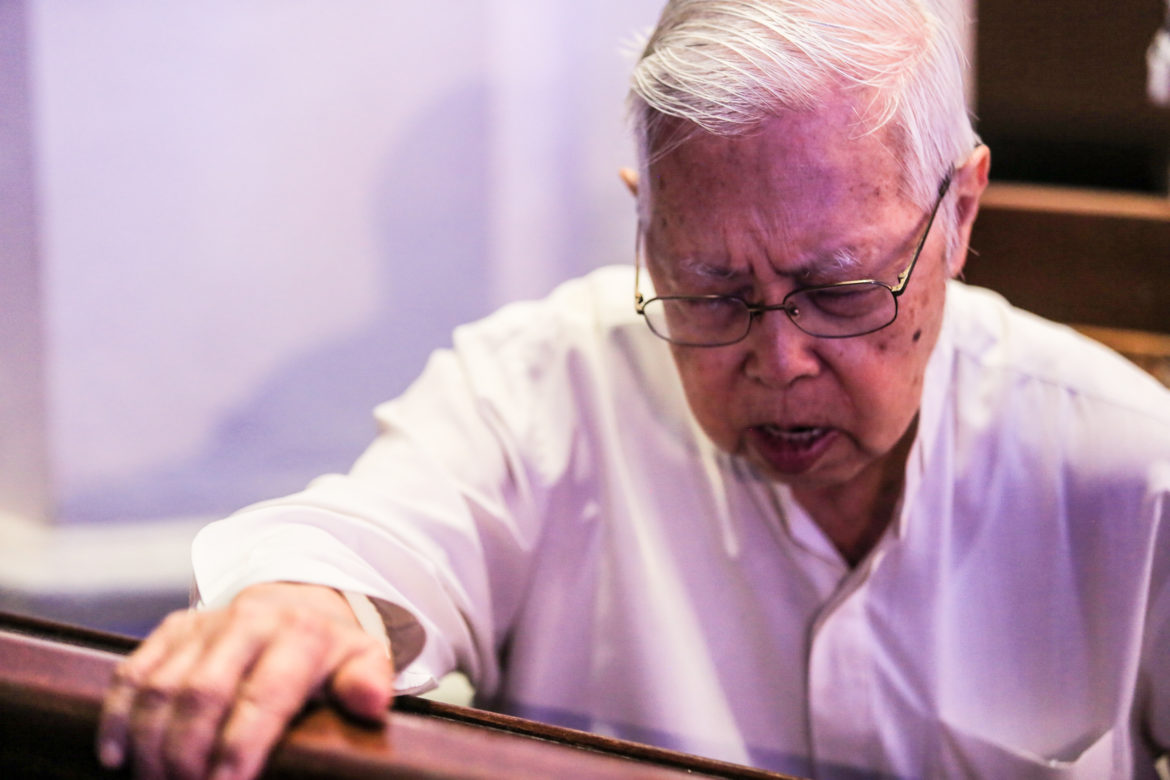
Written by: Lemuel Teo (Photo by: Burning Hearts)
Interview with Canon James Wong & Timothy Wong
The unity of the body of Christ in Singapore is something that is close to my heart. At times, differing denominational affiliations and persuasions threaten to unravel the oneness we have in Christ. Yet, one of the things that has consistently brought the churches in Singapore together is the rallying cry to rise up as an Antioch. Billy Graham said in 1978 that Singapore would be like the biblical city of Antioch. Therefore, in 2018, we will mark the 40th year since this was released over our nation.
Canon Dr James Wong, 77, an Anglican minister serving under the Diocese of Singapore for more than five decades, played a significant part in inviting Billy Graham to speak at evangelistic crusades in Singapore in 1978. I had the privilege of sitting down with Canon Dr James Wong and his son, Timothy Wong, 48, in which the former shared more about the landscape of Christianity in Singapore during the 1970-80s. A wave of Charismatic renewal swept across the churches in our nation during those years and Canon James was at the forefront of planting churches in housing estates. Interviewing Timothy was particularly illuminating as he stands between the older “pioneer” generation and today’s millennial generation.
In our conversation, I better understood how generations should work together for the advancement of the gospel. While the older ones empower the young men and women in serving the Lord, the young ones need to honour and build upon the work of our elders.

Canon James Wong and family. Canon James Wong (first row, second from left). Timothy Wong (second row, leftmost).
Why did you invite Billy Graham to speak in Singapore in 1978?
Canon James Wong: I had been to a few conferences where he was the speaker, and I was inspired by his [evangelistic] vision for the world. I felt that Singapore needed to have a vision. So I wrote to Billy Graham asking if he would come to speak in Singapore. I didn’t hear any reply from him, but through his associates, I heard that he was interested in the invitation given to him.
Therefore, in 1977, I went to a crusade which he was conducting in Manila, and it was where I invited him to come to Singapore. He graciously replied, “Yes, I would come if there are churches united together in inviting me.”
When I came back, I talked to a few of my colleagues and we formed an invitation committee. Dr Benjamin Chew was the chairman of the committee. We wrote an official invitation to him to come speak in Singapore and he graciously agreed.
What do you remember about the Billy Graham evangelistic crusades in December 1978?
Canon James Wong: It was at the height of the [Charismatic] renewal in the 1970s. Even though we felt that December was not the best time, Billy Graham’s schedule was free then. So we took a step of faith and booked the National Stadium — that was the only place big enough for the crusade.
It was the first time such a large crusade was held and there were many miracles. Over those five days, it would rain in the daytime, but when evening came, the weather would be fine, so we were able to conduct the crusades in the open air.
We didn’t know whether we could fill the stadium. Yet, every night, it was packed — 50,000 people came to hear Billy Graham preach. On the final day — it was a Sunday — the stadium was overflowing with people, 20,000 of them could not get in and had to stand outside. Many people came forward to the altar call to accept Jesus Christ as their Lord and Saviour. The crowd was so large that there weren’t enough counsellors.
From that event, we felt that the church in Singapore was revitalised. Revival came to the churches, and many came to know the Lord.
What was it like for Christianity in Singapore during the 1970-80s?
Canon James Wong: Billy Graham challenged the church in Singapore to be a missionary-sending church. He prophesied that Singapore would be like Antioch in the New Testament, sending missionaries to all of Asia.
After the crusades, we formed the Evangelical Fellowship of Singapore (EFOS), which was responsible for gathering the churches in Singapore together, and the Singapore Centre for Evangelism and Missions (SCEM), a missions-sending body.
The church in Singapore was transformed through the Holy Spirit revival and became more evangelistic-minded and fervent for the gospel. Christianity in Singapore grew from 8% to close to 20%, which is a significant growth. Through the revival, starting in 1972, many new churches were birthed, like Faith Community Baptist Church, Calvary Charismatic Centre (now Victory Family Centre), Lighthouse Evangelism, City Harvest Church, and many other churches. The church in Singapore became a sending church – young people offered themselves to full-time service for the Kingdom of God.
It was wonderful to see the tremendous rise of churches and the young people making significant contributions in the advancement of the gospel.
Canon James, you had a role in planting many churches in Singapore: Marine Parade Christian Centre, Chapel of the Resurrection, Bukit Timah Christian Centre (now Chapel of Christ the King), Whampoa Christian Centre (now Chapel of the Holy Spirit). What drove you in your church planting work in Singapore?
Canon James Wong: I was challenged by the Lord to plant churches. I saw the need to have churches in the housing estates and my vision was to plant a church in every housing estate and to reach out to the community. Working with the Holy Spirit, we began to see new congregations being built up in the housing estates, opening the way for many to know Jesus.
The older generation has prayed and laboured a lot for the church in Singapore to grow in the past decades. Lou Engle, in the Kingdom Invasion conference this year, said that the younger generation needs to honour the older generation by “entering into their sacrifices and passion that birthed the revival 40 years ago.” What do you think this looks like?
Timothy Wong: In order to step into their sacrifices and passions, it involves thinking, “It’s not about me; it’s about God and the people He loves.” As your generation realises that it is not about yourselves, but it is about the people in the next generation, you’ll be able to go further than what our fathers did. You stand on the shoulders of those who have gone before you.
I imagine a young generation of Christians honouring the work of those who have gone before, and entering into whatever God has called Singapore to do, and to take it to the next level. This can happen when the hearts of the fathers turn towards the hearts of the children, and vice versa (Malachi 4:6).
The spirit of this age would say, “I can do better than my father.” But I think the Spirit of Christ would say, “I can honour what my father did and build on what he has done.” I think this would take you further and is very powerful.
As a father myself, I think that fathers have an innate desire to release our sons and daughters into God’s work. As a church leader, if you see a young man or woman who wants to branch out, do you hold them back, or do you support them and bless the dreams that God has laid on their hearts?
When my dad planted churches, it was basically to release fresh groups of leaders and not hold them back. The natural tendency is to hold them back so that you can build your church, instead of saying, “Go, I release you.”
As the older generation passes on the mantle of leadership to the younger generation, what is on your heart for the younger generation?
Canon James Wong: My heart is that they come to know Jesus Christ as Lord and Saviour, as a ruler of this nation. Young people have got a lot of distractions, but there is a need to be single-minded in following Jesus – to be faithful to Him, to go where He wants them to go, and do what He wants them to do. So set your mind of things above, where Christ is, and be faithful to the calling of Jesus Christ. Follow Him.
I also hope that their career will not be the most important thing in life. I pray that they will have Jesus in their hearts — whole-heartedly following him, seeking to go forth in the power of the Holy Spirit, and bearing witness for Jesus Christ boldly.
Lastly, I would like to see many young people coming forth to serve Jesus Christ in the full-time ministry.



Joshua Cheong
7 August
Hi Lemuel,
It is great to read this and read your article. I am from Chapel of the Resurrection and have been attending there since I was a child. Pastor James was instrumental to my church. So happy that he was featured.
Best regards,
Joshua Cheong
Brenda Lye
7 August
I accepted Christ during Billy Graham crusade 1978. I was 13 then n remember gathering with teachers n friends after school to go Bible House to help sort tracts/materials in preparation for the crusade.
This is the first time I read about the background story of how Billy Graham crusade came to Singapore! Thank you !